

WhatsApp has become one of the most used social media messaging apps, with over 3 billion unique users and 2 billion active users monthly. It is used by people to contact their friends and family members. A lot of businesses also use it for customer service and outreach.
However, the issue is that most WhatsApp messages are opened within minutes, yet very few actually get a reply. This is because many messages sound predictable and generic. This provides people with little reason to respond.
In this blog, we will discuss effective ways to create appealing WhatsApp messages that spark curiosity and lead to increased engagement.
Continue reading to know amazing ways to compel the reader to reply to your message.
1) Start the Message Without Saying Everything
Curiosity usually appears when something feels incomplete. When a message gives full information at once, the reader has nothing left to think about. That is why messages that leave a small gap often perform better on WhatsApp.
An effective way to do this is by starting a thought and stopping before finishing it. Instead of sharing full details, you just give enough info to make the reader wonder. For example, if you say something unexpected related to work or daily life and pause there, the other person naturally wants to know more. Here is an example:
“You will never guess what happened at work today. Let me know when you are free to talk!”
2) Ask Questions That Feel Worth Answering
Most WhatsApp conversations finish because the first question feels routine. Messages like “How are you?” or “What’s going on?” do not give the reader a reason to stop and think. So, many users find no real interest in continuing the chat.
A better approach is to ask questions that invite imagination or opinion. When a question makes someone picture a situation, they naturally want to answer it. For example, asking how someone would spend a free day with no plans pushes the mind into thinking mode. It feels light and personal at the same time.
Here’s how you can do it:
“What’s one thing you’ve always wanted to try but haven’t yet?”
You can also ask about experiences or preferences. Questions about goals, plans, or things they want to try create space for real conversation. People are more likely to reply when they are asked about what they think, not what they know.
3) Use Repetition to Grab and Hold Attention
Creating repetition in WhatsApp messages looks unusual; that’s why it may spark curiosity in the reader’s mind. One reason repetition works is that it signals importance. If a line appears again, suddenly the reader wonders why it is repeated.
For example, a simple sentence like “There’s news about your interview” has a normal impact. But when you write it multiple times, the reader stops and asks, “Why is this repeated?” That pause makes them more likely to reply.
Another reason is emotional emphasis. Sometimes the message carries a tone that feels personal or urgent. Repeating part of a sentence can make it feel more real. That is just like how we repeat the same words or phrases when we are in a hurry.
To create repetition in a WhatsApp message, you can copy and paste the same line. If it feels overwhelming, you can use text repeater tool for this. It can repeat sentences as many times as needed in no time. Here is an example:

4) Use WhatsApp’s Built-In Formatting
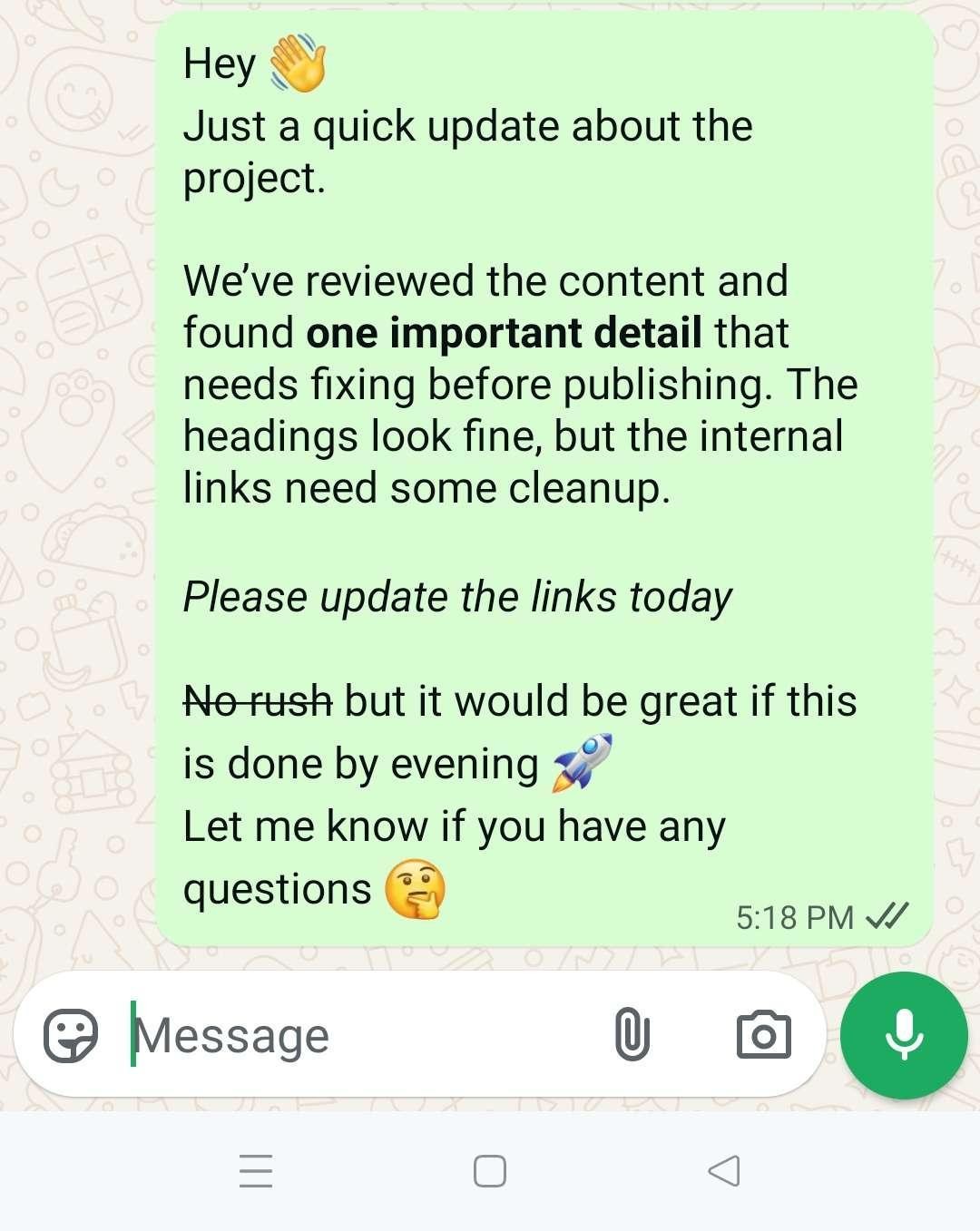
WhatsApp already gives simple text formatting options, but most people ignore them. When used carefully, these small changes can draw attention to a specific word or line. The key point is moderation. If everything looks normal and one part looks different, the reader notices it immediately.
You can bold or italicize short phrases like “quick update” or “important detail” to draw attention. Typewriter-style text feels unusual and can suggest something special or private. Also, light use of strikethrough can attract the focus of the reader instantly.
Using emojis sparingly can also make the message more interesting and attractive. A well-placed emoji (like a thinking face 🤔, rocket 🚀, or sparkle ✨) or a relevant GIF can add personality and draw the eye to your message. Here is an example of a message using WhatsApp’s built-in formatting:
Final Words
WhatsApp is a simple app, but the way people behave on it is not simple at all. A message either feels worth replying to, or it gets ignored without much thought. That is why curiosity matters so much here. It buys you a few extra seconds of attention, and those seconds decide whether a conversation moves forward or finishes quietly.
The tricks discussed in this blog are not complicated, and that is the point. You do not need clever words or long messages. You only need to stop sending predictable texts. Leaving a thought incomplete, asking better questions, repeating a line when it makes sense, or using basic formatting can completely change how a message feels to the reader.
It is also important to remember that curiosity should feel natural. Overdoing any of these techniques can make a message feel forced.