

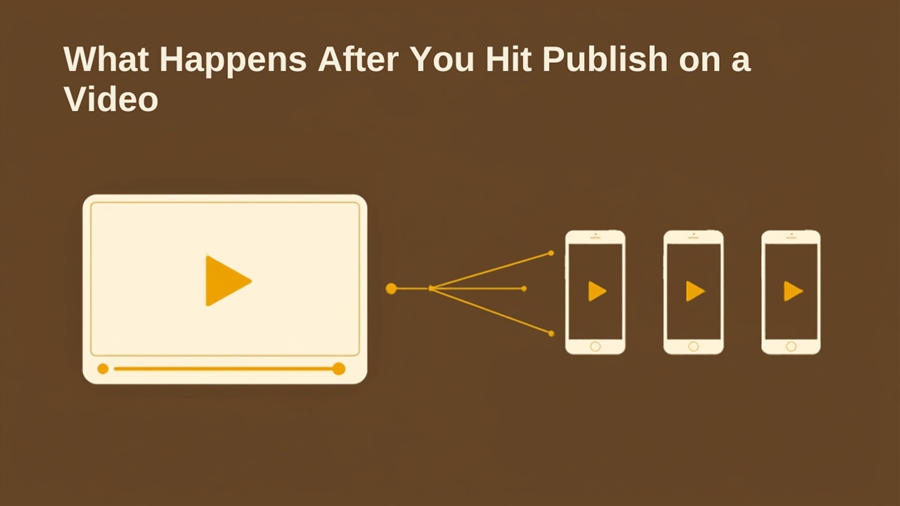
Most teams treat publishing as the finish line. The script went through three rounds of notes, the edit took two days, the captions were checked, and then the file goes up and everyone moves to the next task. A week later somebody pulls the numbers and the video has three hundred views, most of them from the team.
The work was real. The distribution was never planned. Production and distribution are separate problems, and only one of them gets a budget in most organisations.
Publishing Is Not Distribution
A new video on a small YouTube channel enters a queue with no reputation attached to it. YouTube has no history suggesting who should see this, so it runs a narrow test, watches retention and reaction, and decides from there whether to widen the audience. A video that gets a weak first test does not get a second one, regardless of how good the last thirty seconds were.
This is where the awkward part of the conversation usually starts. Some publishers respond by paying for an initial view push to get past the empty room problem, and detailed YouTube provider comparisons exist because the demand is steady. It is a tactic with real limits, since views arriving without watch time teach the recommendation system the wrong lesson, but pretending nobody does it has never made anyone’s numbers better.
The First Test Group Decides a Lot
Retention in the opening seconds does more work than any other input. If half the test audience leaves in the first ten seconds, nothing that follows gets measured, because almost nobody reaches it.
Teams that fix this rarely do it by making better videos in general. They do it by cutting the first fifteen seconds of the video they already made. The logo card, the channel introduction, the slow context setting paragraph that felt necessary in the script review, all of it goes. What remains is the thing the viewer came for, delivered immediately, with the background filled in afterward for the people who stayed.
Volume Is Not a Distribution Strategy
The cheap production tools available now make it tempting to solve the problem with output. If one video reached three hundred people, thirty videos should reach nine thousand. That arithmetic does not hold.
Thirty videos means thirty separate tests, and thirty weak results teach the system more about the channel than three strong ones would. A channel that consistently produces content people abandon early gets read as a channel that produces content people abandon early. Output without a corresponding lift in quality moves a channel backwards, and it does so faster than a slower publishing schedule would.
There is an internal cost as well that rarely appears in the plan. Every additional video needs review, approval, captions, thumbnails and a place to live, and those steps do not get cheaper when generation does. Teams that scale production without scaling the approval path end up with a queue of finished files waiting on one person, which is a familiar bottleneck wearing an unfamiliar label. The publishing schedule a team can sustain is set by that step, not by how quickly footage can be produced.
Give the File a Job Before You Export It
The most useful change is procedural rather than creative. Before a video enters production, write down where it will be seen and who is expected to pass it on.
That means naming the internal channels it goes into, the newsletter section it belongs in, the two or three communities where it is genuinely on topic, and the people who will actually share it rather than the ones who might. It also means deciding what the video is being cut down into. A single long form piece that produces four short vertical clips has five distribution surfaces instead of one, and the clips do the work of finding an audience for the long version. That planning gets sharper when compare short clip results shows which edits pull people in and which ones stall. A simple view of retention and clicks helps the team choose the next cut.
Writing that down before production also changes what gets made. A video with three named destinations tends to get structured so it works in all three, which usually means shorter segments and a clearer break between sections. A video with no named destination gets structured for whoever is in the review meeting.
Measure the Right Thing Early
View count answers the least useful question available. Average view duration, which YouTube reports directly beside it, says whether the video held anyone. The click through rate on the thumbnail says whether the packaging worked. Together they tell you which half of the process failed.
Low clicks with strong retention means the content was fine and the framing was wrong, which is a cheap fix. Strong clicks with weak retention means the packaging wrote a cheque the video could not cover, which is a harder conversation but a more useful one. Teams that separate those two numbers stop arguing about whether video works and start arguing about which specific step to change.
Frequently Asked Questions
How long should a business video be?
Long enough to answer the question and no longer, which for most business topics lands between two and six minutes. Length matters far less than whether the pace holds.
Is it worth reposting an old video that underperformed?
Recutting the opening and republishing often works better than reposting the same file. YouTube treats it as a fresh test, and the new opening is what changes the outcome.
Should short clips link back to the long video?
Clips generally perform better as standalone pieces, with the long version mentioned rather than pushed. Sending viewers away mid clip tends to cost more retention than the referral is worth.
How many platforms should one video go to?
Two or three done properly beats six done automatically, since each surface expects a different aspect ratio and pacing. Blanket cross posting is usually visible to viewers and reads as low effort.