

You asked ChatGPT for a first draft, and it gave you one. The facts are mostly right, and the structure is fine, but when you read it back, it does not sound like you. It sounds like everyone. The sentences are tidy, the transitions are smooth, and there is nothing in it that you would actually say out loud.
That gap is what people mean when they talk about how to humanize AI text. This guide is about closing it honestly: getting your own voice, knowledge, and opinions back into a draft, rather than disguising where it came from.
Why AI drafts all sound the same
Language models write by choosing likely words. Likely words are, by definition, the ones most people would use, so the result drifts toward the average. You get stock openers, safe transitions, and adjectives that do not commit to anything.
The effect is measurable. Researchers analyzing more than 15 million PubMed abstracts found sudden jumps in certain style words after ChatGPT arrived, with “delves” among the best-known examples. In a 2025 study in Science Advances, they estimated that at least 13.5% of biomedical abstracts published in 2024 were processed with a language model, and the share reached 40% in some groups. When that many writers lean on the same tool, their writing starts to sound alike. So the first job when you humanize AI text is to pull it away from that average and back toward the way you think and talk.
“Humanize” should mean editing, not disguising
Search for an AI humanizer, and you will find plenty of tools that promise “100% undetectable” output. That is the wrong goal, for two reasons.
First, AI detectors are not reliable enough to aim at. Stanford researchers ran 91 TOEFL essays written by non-native English speakers through seven popular detectors, and more than half were wrongly flagged as AI-generated. The same study found that simply asking ChatGPT to use fancier vocabulary was enough to make detectors call AI text human. A score that swings that easily is a poor target in either direction.
Second, chasing a score skips the part that matters. A draft that passes a detector can still be generic, wrong, or not yours. A draft that sounds like you, includes what you know and says what you think is better writing, whatever any tool reports. If your school, client, or employer has an AI policy, follow it, including any rules about disclosure.
A five-step routine to rewrite AI text in your own voice
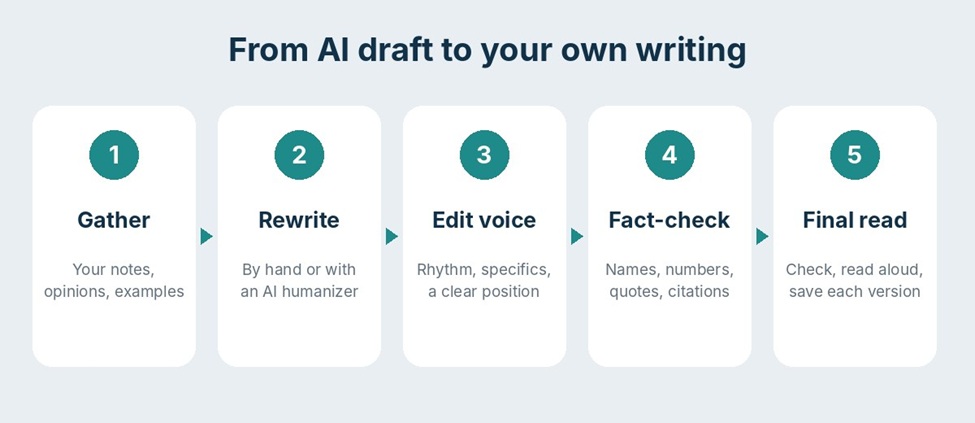
Step 1: Gather your own material first
Before you touch the AI draft, write down what only you can add. That might be a number from your own work, a mistake you made, a specific example, a source you trust, or an opinion you hold. Five rough bullet points are enough. This is the raw material that makes the final piece yours.
Step 2: Do a first-pass rewrite
You can do this by hand or with a tool. If you use one, pick an AI humanizer that is honest about what it does. DetectGPT’s AI humanizer is a free example: it needs no account, takes 30 to 3,000 words per run, and offers modes such as Standard, Fluent, Academic, Formal, Casual, and Concise. It rewrites rhythm and stock phrasing while keeping the meaning, and it does not claim to guarantee a human score or bypass any detector.
Whichever route you take, work in sections rather than pasting a whole long piece at once. Smaller chunks are easier to review, and you will notice more of what changed.
Step 3: Edit for voice
This is the step no tool can do for you. Go through the draft with these questions:
- Would I say this sentence out loud? If not, rephrase it the way you would explain it to a colleague.
- Are the sentences all the same length? Break up long ones and let a few short ones stand on their own.
- Which transitions are filler? Cut “furthermore”, “moreover,” and “additionally”, or replace them with the connectors you actually use.
- Where is the detail? Add the specifics from Step 1: a real figure, a name, a constraint, an example.
- What do I think? Generic drafts hedge everything. Take a position where you have one.
- Does the ending just repeat the middle? Replace the summary paragraph with a conclusion, a recommendation, or a next step.
Here is the difference in practice. Both versions below cover the same topic, but only one sounds like a person who was there.
Step 4: Check every fact
Any rewrite, whether done by hand or by a tool, can quietly change meaning. Check names, numbers, dates, and claims against your sources. In academic work, leave direct quotations and citations exactly as they were, and make sure you can explain every point in your own words if someone asks.
Step 5: Do a final read and check
Read the finished piece out loud. Anything that makes you stumble or sounds like a brochure needs another pass. If you want a second opinion, run it through a free checker such as DetectGPT and look at which lines are highlighted, not just the overall percentage. Treat the result as a pointer to weak passages, not a verdict on who wrote the text. Then save a copy of the version you submit.
Keep a record of your process
If anyone ever questions your work, your drafts are the strongest evidence you have. Keep your notes, the AI draft, your edited versions, and the final copy. Version history in Google Docs or Word does this automatically. A clear record protects you far better than any score, and it makes disclosure easy when a policy asks for it.
What to avoid when you humanize AI text
- Synonym spinners. Tools that swap every third word produce awkward text that reads worse than the original.
- Invisible characters and odd formatting tricks. They break text in other software and look like an attempt to hide something.
- Publishing without reading. Every rewrite needs a human read, especially for facts and tone.
- Deliberately adding errors. Typos make writing worse and do not make it more yours.
- Ignoring the policy. If AI help must be disclosed, disclose it, however much you edited.
Frequently asked questions
Is using an AI humanizer cheating?
It depends on the rules you are working under. Using a tool to improve the flow of a draft you are responsible for is similar to using any editing aid. Using it to pass off work you did not do, where that is forbidden, is not. Check your course, client, or company policy.
Will humanized text always pass an AI detector?
No, and no honest tool will promise that. Detectors disagree with each other and change over time. Focus on making the writing clear, specific, and yours.
What is the fastest way to rewrite AI text by hand?
Start by deleting the opening and closing paragraphs, which are usually the most generic. Then add one specific detail to each section, vary sentence length, and replace stock transitions. That alone changes how a draft reads.
How long does it take to humanize AI text properly?
For a 1,000-word piece, plan on 20 to 30 minutes: a few minutes to gather your notes, a quick rewrite pass, then most of the time on the voice edit and fact-check. A tool can speed up the rewrite, but the editing time is what makes the difference.
Can an AI humanizer handle academic writing?
Some offer an academic mode, which keeps a formal tone. Still check that citations, quotations, and technical terms are unchanged, since a rewrite can alter them.
The bottom line
AI can give you a starting point, but it cannot give you your voice. An AI humanizer can loosen the rhythm of a stiff draft, and that is useful. The real work is adding what you know, saying what you think, checking the facts, and keeping an honest record. Do that, and the writing will sound like you because it is yours.