


It is annoying when someone says your own writing looks like AI, and it happens all the time now. Usually it comes down to one score from an AI detector, and two detectors can give very different scores for the same text.
So we ran five popular ones on the same essays to see which one holds up best.
When the Score Says AI and You Wrote It
You spend an evening on an essay. Every sentence is yours; a chatbot only fixed the commas, and then an AI checker calls the text machine-made. Suddenly you have to prove you wrote it.
The unfair part is that a detector never knows who wrote what. It only guesses from patterns, so even a good AI text detector gets it wrong in a few familiar ways. Once a humanizer touches the text, it gets harder to detect AI writing, and the mistakes pile up.
- A grammar tool smooths a few sentences, and the detector decides the whole essay is machine-made.
- Someone runs a chatbot draft through a humanizer, and the same detector shrugs it off.
- A careful, formulaic essay gets flagged just because it reads like a template.
People in education worry about exactly this. Jisc, which advises UK universities, warned that even a 1 percent false positive rate adds up to thousands of wrong flags at a large university. Any AI detection tool carries that risk.
So treat a flag as a question, not a verdict. Read the marked sentences, then paste the same paragraph into the AI detector text field of a second tool. If you wrote it yourself, rephrase your text and scan again. Before you check for AI in anything that matters, that small habit saves a lot of stress.
With that in mind, here is how five tools scored.
The Five Best Detectors
Here are the five best AI writing detectors from a public essay test of eight tools, run by Clever’s research team. GPTZero, ZeroGPT, and QuillBot scored lower, so they did not make the list. Our top pick comes first, and the rest follow by use case.
Clever AI Detector
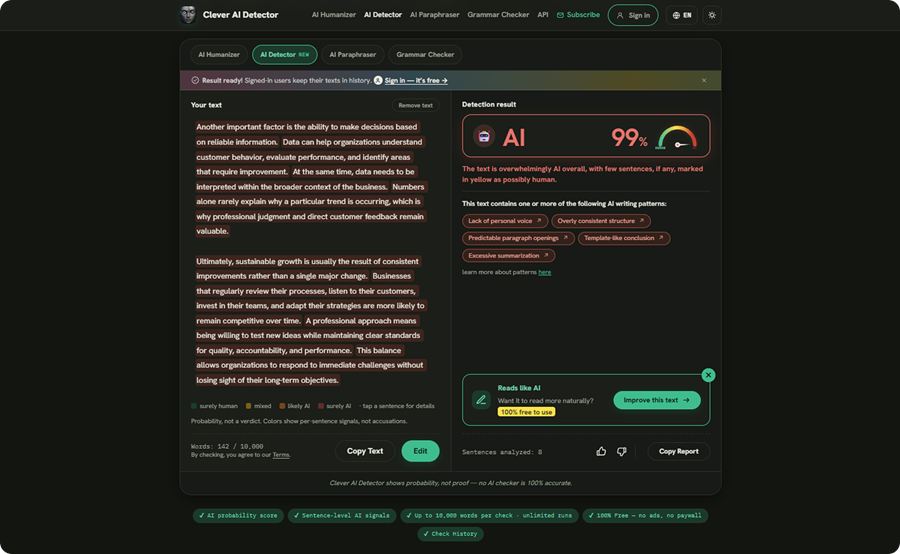
Clever leads the average, and consistency explains why. In the essay test, it never fell far on any kind of text, so we call it the best accurate AI detector of the five, and the most accurate AI detector here when you do not know how someone edited a text. It suits anyone who wants a quick, free check on their own drafts.
It also costs nothing, which makes it the free, accurate AI detector to open first. Drop in text or attach a file, hit Check for AI, and you get a probability with the suspect sentences highlighted. The page itself calls the score a probability, not proof. If a paragraph still sounds stiff, you can reword it with the best free AI humanizer and scan again.
Main advantage: Steady results on every kind of text, free and with no sign-up.
| Feature | Details |
| Test scores | Raw 100.0, rewritten 100.0, improved 94.7, humanized 92.0 |
| Average | 96.7% |
| Lowest category | Humanized, 92.0% |
| Detection models | 20 named models |
| Analysis type | Score and sentence highlights |
| Languages | English, Spanish |
| Text limits | 80 to 10,000 words |
| Free route | Unlimited, no sign-up |
| Paid route | None |
| Extras | File upload, Copy Report, check history |
| Vendor note | Score is a probability, not proof |
| Use it for | Your own drafts |
Originality.ai
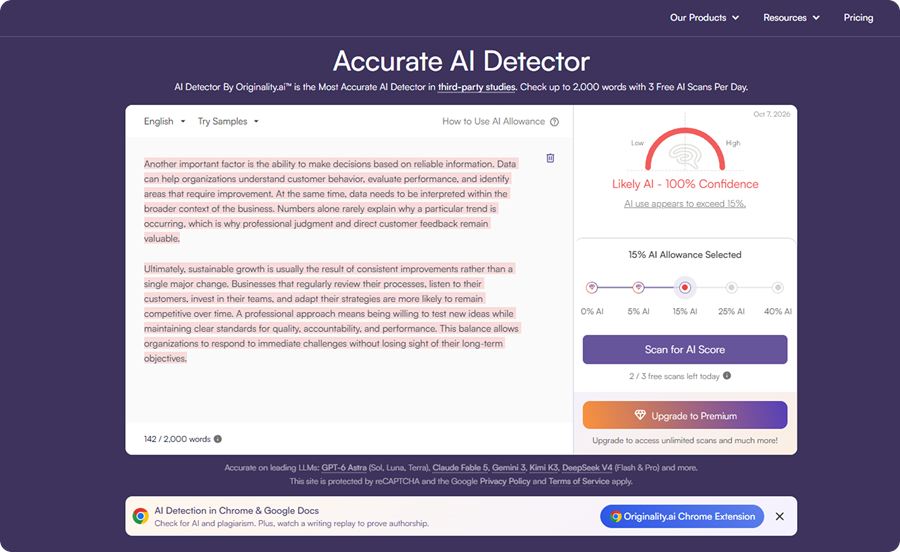
Originality.ai is the most accurate AI content detector of the five on drafts that a person wrote and a model only cleaned up, though only by a small margin. It slips once a humanizer rewrites the text, so it fits editors and publishers who check drafts before they go live.
The vendor also warns that AI editing tools, certain Grammarly features included, can trigger false positives.
Main advantage: The best result on AI-improved drafts, plus plagiarism and readability checks in the same tool.
| Feature | Details |
| Test scores | Raw 100.0, rewritten 100.0, improved 96.0, humanized 51.3 (Lite model) |
| Average | 86.8% |
| Lowest category | Humanized, 51.3% |
| Detection models | GPT, Claude, Gemini, DeepSeek |
| Analysis type | Probability, highlights, PDF report |
| Languages | 30 |
| Text limits | 100 words minimum |
| Free route | 3 scans a day, 2,000 words each |
| Paid route | Pro $14.95 monthly, $12.95 yearly |
| Extras | Plagiarism, readability, grammar, site scans, Chrome extension, 30-day history |
| Vendor note | AI editing tools can cause false flags |
| Use it for | Light edits, editorial teams |
Copyleaks
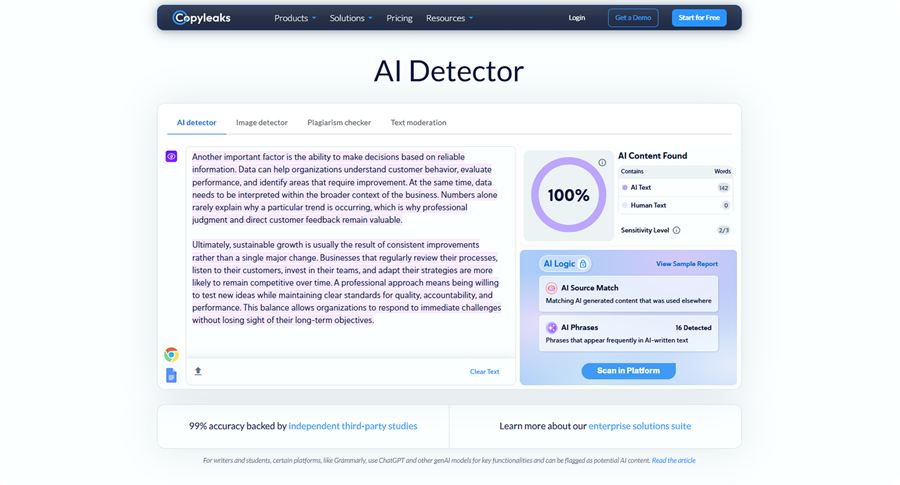
Copyleaks comes very close to the leader, and against humanizers it ranks as the most accurate AI checker in the test, ahead of Clever by two essays. Drafts that a model only cleaned up are its softer spot. It suits anyone who checks text that is not English, since it reads over thirty languages, and anyone who wants a strong second opinion on text that may have passed through a humanizer.
Main advantage: The best result on humanized text, and wide language coverage.
| Feature | Details |
| Test scores | Raw 100.0, rewritten 100.0, improved 86.7, humanized 93.3 |
| Average | 95.0% |
| Lowest category | Improved, 86.7% |
| Detection models | ChatGPT, Gemini, Claude, DeepSeek |
| Analysis type | Percentage, sentence highlights |
| Languages | 30+ |
| Text limits | About 25,000 words a month on Personal |
| Free route | 25,000 characters, no login, more credits with an account |
| Paid route | Personal $16.99 monthly, Pro $99.99 monthly |
| Extras | Chrome, Edge, Firefox extensions, Docs add-on, Canvas, Moodle, AI Logic (paid) |
| Vendor note | Claims over 99% accuracy, 0.03% false positives |
| Use it for | Humanized text, many languages |
Pangram
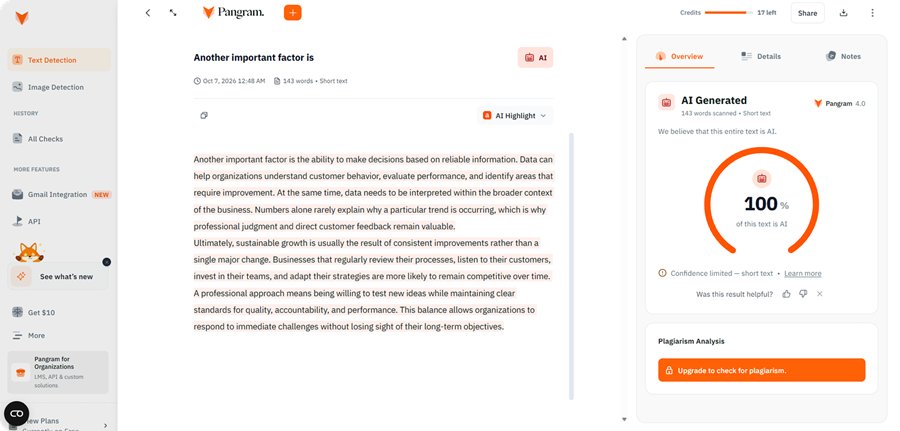
Pangram never missed raw chatbot text, but it struggled with improved drafts and humanized text in this test, partly because it often answers “mixed”, which we counted as not AI. So it sits last on the average. The vendor claims very high accuracy and very few false alarms, which this test did not confirm on edited text. It suits anyone who wants to see which parts of a long document read as AI, since it shows the share of AI text and marks the sections an AI edited.
Main advantage: A clear share-of-AI view that also marks AI-edited sections.
| Feature | Details |
| Test scores | Raw 100.0, rewritten 88.0, improved 18.0, humanized 64.0 |
| Average | 67.5% |
| Lowest category | Improved, 18.0% |
| Detection models | ChatGPT, Claude, Gemini, Grok |
| Analysis type | AI share, edited segments |
| Languages | 20+ |
| Text limits | 300,000 words a month on Individual |
| Free route | 2,000 words daily |
| Paid route | Individual $20 monthly, Professional $65 monthly |
| Extras | Gmail, Google Docs, API, file upload with OCR |
| Vendor note | Claims over 99% accuracy, 1 false alarm in 10,000 |
| Use it for | Long documents, AI-edited sections |
Winston AI
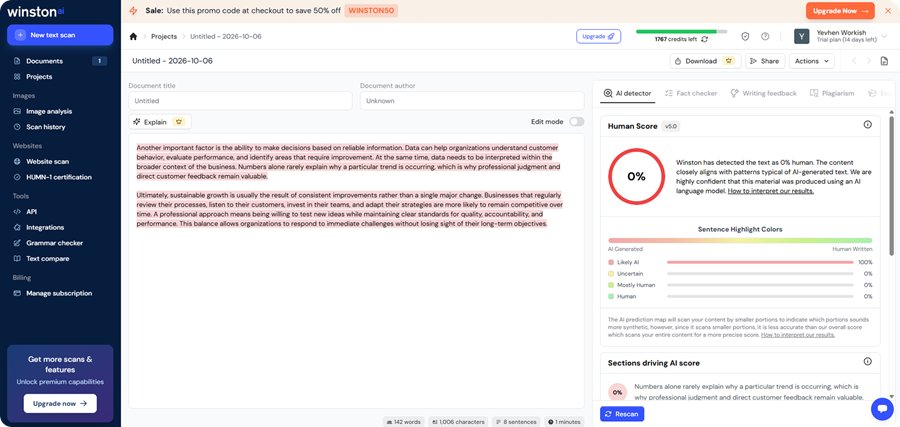
Winston AI caught every raw and rewritten essay in the test, but it caught fewer than half of the humanized essays. It suits people who need to hand over a report, since it colors suspect passages and offers a printable PDF. Its own page claims very high accuracy, but based on internal testing.
Main advantage: Clear reports you can hand to someone else.
| Feature | Details |
| Test scores | Raw 100.0, rewritten 100.0, improved 86.0, humanized 44.7 |
| Average | 82.7% |
| Lowest category | Humanized, 44.7% |
| Detection models | ChatGPT, Gemini, Claude, Llama |
| Analysis type | Color map, PDF report |
| Languages | 14 |
| Text limits | Up to 200,000 characters |
| Free route | 14-day trial, 2,000 credits |
| Paid route | Three plans at $18, $29, $49 monthly, regular price |
| Extras | Plagiarism, OCR, image and deepfake checks, team invites |
| Vendor note | Claims 99.87% accuracy, own testing |
| Use it for | Reports for others |
Summary Table of Test Results
Claims on a landing page are cheap, but the same essays handed to five detectors tell a clearer story. Each tool saw 150 essays per category from a public Bielefeld University dataset in August 2026, and the table shows how many it called AI. Raw is an essay a model wrote from the assignment alone. Rewritten is a student’s essay that a model reworded, and Improved is a student’s essay where a model only fixed the grammar. Humanized is model text that the DIPPER paraphraser, built to fool detectors, then reworded.
| Detector | Raw | Rewritten | Improved | Humanized | Average |
| Clever AI Detector | 100.0% | 100.0% | 94.7% | 92.0% | 96.7% |
| Copyleaks | 100.0% | 100.0% | 86.7% | 93.3% | 95.0% |
| Originality.ai | 100.0% | 100.0% | 96.0% | 51.3% | 86.8% |
| Winston AI | 100.0% | 100.0% | 86.0% | 44.7% | 82.7% |
| Pangram | 100.0% | 88.0% | 18.0% | 64.0% | 67.5% |
The table sorts tools by average score, so its order differs a little from the use-case order above. Two cautions apply. The test counted Rewritten and Improved essays as AI, while the dataset authors treat them as human, so a high score in those columns is not automatically a win. A verdict of “mixed” counted as not AI, which lowers Pangram most. Each average is a simple mean of the four categories. With the numbers in front of you, here is our verdict.
Final Words
Our pick is Clever AI Detector, and the reason is simple. It never fell apart on any type of text, which matters when you cannot tell how a draft changed. If you suspect the draft went through a humanizer, run it through Copyleaks too.
Still, no table beats a quick test of your own. Paste in a paragraph you wrote and one that came from a chatbot, and see whether the tool gets both right. Six more questions follow.
FAQ
What should I do if a detector flags text I wrote myself?
Stay calm and gather proof. Open the file’s version history, collect your notes and outlines, and run the same text through a second detector. A score is a guess about patterns, and your drafts show how the piece came together.
Should I scan a whole document or one section at a time?
Start with the whole document, then look at the sentence highlights to see where the score comes from. If one section lights up, rescan just that part. A single odd paragraph can explain a high overall number.
How do I fix a flagged paragraph without rewriting everything?
Change the highlighted sentences first. Add a detail only you know, vary the sentence length, and cut stock phrases. Then scan again, and stop as soon as the paragraph reads like you.
Can a grammar tool make my own writing look like AI?
It can. Originality.ai warns that AI editing tools, including some Grammarly features, may cause false positives. Keep a copy of the draft you wrote before any tool touched it, so you can show what changed.
Is a one percent false alarm rate really small?
Less than it sounds. Jisc notes that even 1 to 2 percent adds up to thousands of wrongly flagged assessments at a large university. A tool that never flagged our 150 human essays still needs a human to read the result.
Will these results still hold after the next chatbot update?
Not automatically. Chatbots change, and detectors retrain in response, so a ranking is a snapshot. We last checked features and prices on 6 October 2026. A fresh test on your own samples every three months keeps you honest.