

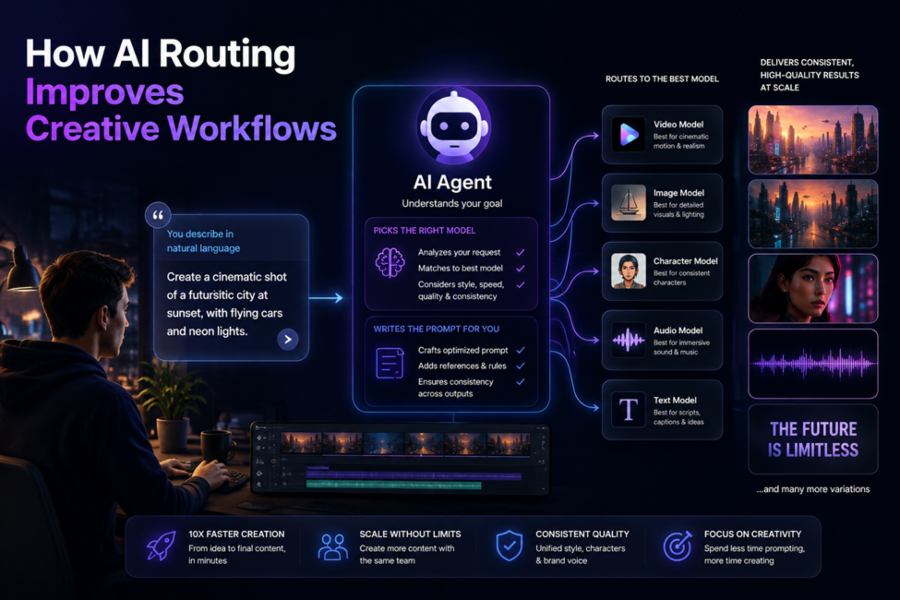
AI routing changes creative workflows by helping teams choose the right model, write better prompts, and produce consistent results without managing every technical step. Instead of learning how each AI model works, creators can describe their goal in natural language and let intelligent systems handle model selection, prompt creation, and production steps. This approach helps teams create more content with better control and fewer repeated tasks.
Why is prompt engineering & routing changing creative work?
Creating high-quality AI content often requires more than a good idea. Creators need to understand which model fits the task, how to write effective instructions, and how to adjust outputs when the result does not match their vision.
This creates a new challenge. Creative teams spend more time managing AI tools instead of focusing on storytelling, design, and strategy.
According to a report from McKinsey’s research on generative AI adoption, generative AI can create major productivity gains across different business functions. However, getting value from these systems depends on how well they fit into existing workflows.
Prompt engineering & routing solves part of this problem by connecting creative intent with the right AI capabilities. Instead of manually testing multiple models, creators can describe what they want and allow an AI system to decide how to execute the request.
This does not remove creative direction. It changes where creators spend their time. They can focus more on decisions, ideas, and quality control while AI handles technical steps behind the scenes.
What does prompt engineering & routing actually do?
Prompt engineering & routing helps AI systems understand a creative request and decide the best way to complete it. It combines natural language instructions, prompt creation, and model selection into one workflow.
A creator might describe a scene like:
“Create a cinematic close-up of a product at sunset with a premium lifestyle feel.”
Instead of manually deciding which model should create the image, writing a detailed prompt, and testing several versions, an AI routing system can handle those steps.
The workflow usually includes:
- Understanding the user’s creative goal
- Selecting the best AI model for the task
- Creating a model-specific prompt
- Applying references or project rules
- Reviewing results and improving outputs
This approach becomes more useful as AI platforms add more specialized models. Different models may perform better for different needs, such as realistic images, character consistency, motion, editing, or audio.
The challenge is no longer only creating content. It is knowing which tools should handle each part of the process.
How does AI routing improve creative workflows?
AI routing improves creative workflows by reducing manual decisions around model selection and prompting. It allows creators to describe outcomes instead of managing every technical instruction required to reach them.
Traditional AI workflows often require creators to learn the strengths and weaknesses of different models. A filmmaker may need one model for realistic characters, another for motion, and another for image creation.
With AI routing, the system can connect the request with the right capability. This creates a smoother path from idea to final output.
For example, invideo Agent works as an AI filmmaking collaborator that helps creators move from an idea to finished video production. It can understand a creative brief, write prompts, select models, and manage references across a project.
The benefit is not only speed. It also helps maintain consistency. A creative project usually contains many connected decisions, including characters, locations, style, and visual direction. A routing system can use those decisions when generating new content.
This is especially useful for:
- Film projects with multiple scenes
- Brand campaigns with many variations
- Social media content requiring frequent updates
- Product videos that need consistent visuals
How does prompt engineering & routing reduce manual AI work?
Prompt engineering & routing reduce manual AI work by allowing creators to communicate ideas naturally while AI systems handle technical prompt creation and model selection.
Many creators understand what they want visually but do not want to spend hours learning how each AI model interprets instructions.
A filmmaker may know they want:
“A slow camera push toward the character as warm evening light fills the room.”
They may not want to translate that idea into a long technical prompt.
This is where agent-based platforms become useful. Invideo Agent allows creators to describe shots in natural language and handles the prompt-writing process, reference attachment, and model execution.
The creator remains responsible for the creative decision. The AI handles the translation between human direction and machine instructions.
This creates a different working style. Instead of acting like a prompt writer, the creator works more like a director giving feedback to a production team.
The same idea applies beyond video. Marketing teams, designers, and content creators can use AI routing to reduce repetitive setup work and spend more time improving the final result.
For teams managing AI content operations, understanding how to review and maintain quality across generative systems is also important. A guide on auditing generative models for content operations explains how teams can evaluate AI workflows more effectively.
How do AI agents choose the right model?
AI agents choose models by understanding what each model does best and matching those strengths with the creative requirement. This helps creators avoid manually testing many tools for every task.
Modern AI platforms often include many specialized models. Some may perform better for realistic images, some for movement, and others for specific editing or visual styles.
A routing system acts like a creative coordinator. It considers the request, project context, and available models before deciding where the task should go.
Invideo Agent uses access to more than 200 image, video, audio, and music models, with routing based on the needs of each shot. The goal is to match each creative requirement with the model that can deliver the strongest result.
For example, a campaign may require:
- Product images with accurate details
- Short videos with specific movement
- Multiple versions for different platforms
- Consistent characters across scenes
Instead of forcing one model to handle every task, routing allows different models to contribute where they perform best.
A similar approach appears when using Nano Banana 2 AI inside an agentic workflow. The agent routes work to the model where it performs best, writes the prompts, and keeps visual direction consistent across generations. Nano Banana 2 sits among a wider group of models that can support different creative requirements, including speed, volume, and visual accuracy.
How does invideo Agent apply AI routing in creative projects?
Invideo Agent applies AI routing by combining creative direction with automated production decisions. Users can explain the result they want, and the system helps manage prompts, references, models, and project consistency.
A major challenge in AI video creation is maintaining continuity. A character created in one scene may look different in another. A location may change unexpectedly. Brand visuals may become inconsistent.
Invideo Agent addresses this through project memory. It keeps important details about characters, products, locations, and creative style throughout a project.
This makes AI workflows closer to traditional creative production. A filmmaker does not need to explain the entire project every time a new scene begins.
The platform can also support different creative roles. Teams can work with specialized agents for areas such as production planning, casting, camera decisions, and editing.
For brands, this approach can help create multiple versions of advertisements and product content while keeping important brand rules consistent.
What is the future of AI routing for creative teams?
The future of AI routing will likely focus on making creative systems more aware of context, goals, and long-term projects. Instead of isolated generations, AI tools are moving toward workflows that understand complete creative assignments.
Recent agent-based systems are designed to remember project details, work across different formats, and support collaboration between specialized AI roles.
Invideo Agent Two represents this direction by acting as a frontier intelligence agent for serious creative work. It can understand project context, work with different expert agents, and read materials such as scripts, documents, and videos to support production decisions.
This shift means creators may spend less time operating tools and more time directing outcomes.
The role of AI is becoming less about replacing creative judgment and more about extending what small teams can achieve.
Conclusion
By making AI tools more manageable and linked to creative objectives, prompt engineering and routing are transforming creative workflows. Instead of learning every model and writing every prompt manually, creators can focus on ideas, direction, and final decisions.
AI routing helps teams choose suitable models, maintain consistency, and create content at a larger scale.
The next step for creators is to explore workflows where AI handles repetitive technical tasks while humans guide the vision. How do you think AI routing will change the way creative teams work in the future?
Frequently Asked Questions
What is prompt engineering & routing?
Prompt engineering & routing combines prompt creation with AI model selection. It helps users describe what they want while an AI system decides how to structure instructions and which model should complete the task.
Why is AI routing useful for video creation?
AI routing helps video creators choose suitable models for different production needs. It can reduce manual testing and help maintain consistency across scenes, characters, and visual styles.
Do creators still need to learn prompting?
Creators can benefit from understanding basic prompting, but agent-based systems can reduce the need for writing complex prompts.
How does AI routing help brands?
AI routing helps brands create more consistent content by connecting different creative tasks with suitable AI models. This can support campaigns that require multiple formats, variations, and product-focused videos.
Can AI routing support professional filmmaking?
Yes. AI routing can support filmmaking workflows by helping with planning, generation, editing, and continuity.