

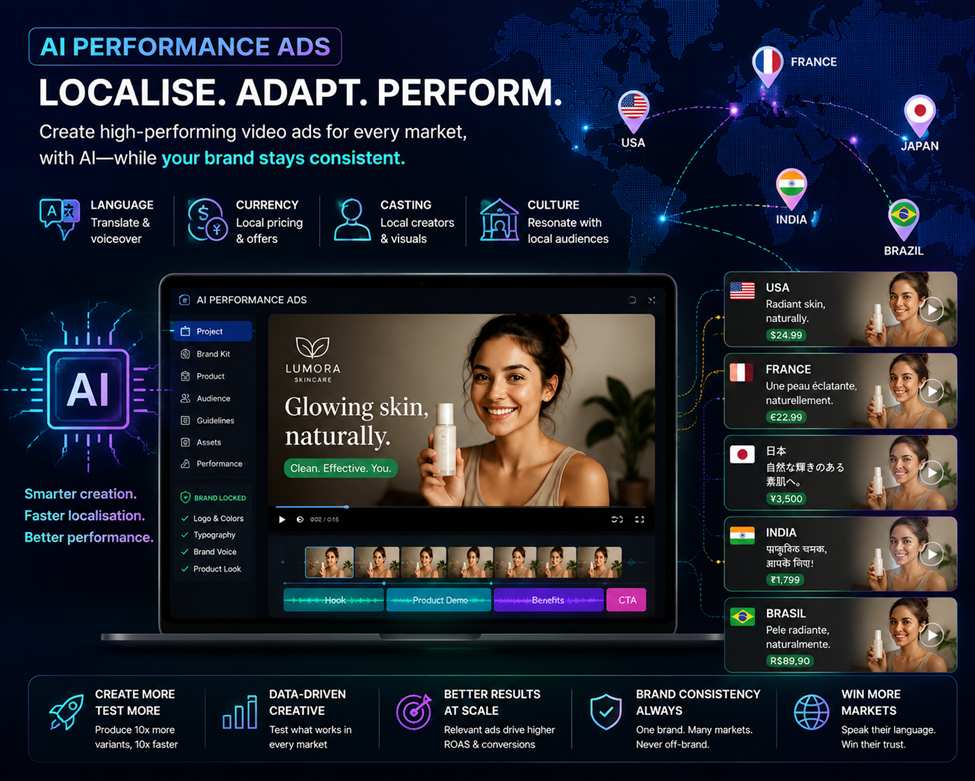
Localising video ads with AI helps brands adapt campaigns for different markets without rebuilding every creative from scratch. AI can help change language, visuals, voice, product messaging, and formats while keeping brand identity consistent.
Global advertising rarely fails because a brand has one bad idea. More often, the challenge is making a good idea work across different markets.
A video ad that performs well in one country may need a different language, creator style, location, product angle, or message before it connects somewhere else. This is where AI Performance Ads can help brands create market-specific versions without losing the original campaign vision.
Traditional localisation often requires multiple teams for translation, editing, voice recording, design changes, and format adjustments. That process can slow down testing and make it harder to learn what works in each market.
AI changes this workflow by helping teams adapt creative assets faster. The goal is not to remove human direction. It is to give marketers more room to test ideas, understand audiences, and build ads that feel natural in each region.
Modern AI tools can support everything from language adaptation to complete campaign variations. The important part is maintaining consistency, so every version still feels like it belongs to the same brand.
How can AI localise video ads for different markets?
AI can localise video ads by adapting elements such as language, voice, visuals, cultural references, product presentation, and placement formats. The best workflows keep the brand identity fixed while changing the parts that need to match local audiences.
Localisation is more than translating words. A successful market adaptation considers how people in a region understand products, respond to messaging, and interact with different platforms.
For example, a skincare brand may use the same core campaign idea across countries but adjust:
- Voiceover language and delivery style
- On-screen text and product benefits
- Creator appearance and setting
- Currency and pricing information
- Cultural references and examples
- Video length and format for local platforms
AI helps manage these changes by giving creative teams a faster way to create and review multiple versions.
An AI agent can analyse a winning ad and create a localisation plan that identifies what should stay and what should change. This includes elements such as character sheets, locations, translated voiceovers, and translated product interfaces.
The important step is keeping the original brand message intact. A localised ad should feel native to the audience without becoming a completely different campaign.
Why do AI Performance Ads need strong brand consistency?
AI Performance Ads work best when brands can create multiple variations without losing their identity. Consistent visuals, messaging, and product details help audiences recognise the brand across different campaigns and markets.
When teams create many ad versions, small differences can appear. A product colour may change, a logo placement may shift, or the tone of voice may become inconsistent.
This is where project memory and brand context become useful. Instead of treating every ad as a separate task, AI systems can work from the same brand foundation.
Invideo Agent stores important project information, including brand guidelines, product details, audience information, and previous creative decisions, so future ads can be built from the same foundation.
A consistent foundation allows teams to explore different creative directions without restarting the process every time.
For example, a fashion brand can create different versions for several regions while keeping the same product details, style, and overall campaign feeling.
AI does not replace creative judgment here. Marketers still decide which audience to target, which message matters, and which version should move forward.
Building localised campaigns with AI agents
The invideo Agent product is designed around the idea of working like a creative production team rather than a simple generation tool. It can help brands build ads from a shared project memory, where different creative tasks connect to the same campaign direction.
A localisation workflow can begin with a successful ad. The team can provide the original creative, explain the goal, and identify which parts need adaptation.
The AI workflow can then help with:
- New market-specific scripts
- Different language versions
- Local creator styles
- Regional product messaging
- New video lengths and formats
- Static and video variations
This approach helps performance teams test more ideas without creating a separate production process for every market.
Invideo Agent can also help analyse why an existing ad works. It can look at the structure, hook, pacing, and offer before rebuilding the concept for another audience.
For marketers exploring scalable creative workflows, AI Performance ads can help teams create more ad variations from one project. Invideo Agent is built to lift the ceiling on how many ads one team can ship. Give it your brand, your product, and the messaging you want the ad to land on, and it builds the hooks, variants, statics, and cutdowns for different placements. Several agents can work in parallel from one project memory, helping teams test more creative directions without expanding production resources.
What should brands change when localising video ads?
Brands should change the parts of an advertisement that affect audience connection while protecting the core message, product identity, and visual language. Localisation works best when teams separate flexible creative elements from fixed brand elements.
The elements that often need adaptation include:
- Language and voice style
- Cultural references
- Audience problems and motivations
- Local pricing or offers
- Backgrounds and locations
- Seasonal messaging
The elements that usually remain consistent include:
- Brand identity
- Product features
- Core campaign idea
- Visual guidelines
- Overall tone
A strong localisation process starts with understanding the market. AI can speed up production, but human knowledge is still needed to judge whether a message feels natural.
A campaign that works in one region may need a different emotional approach somewhere else. A direct sales message may work in one market, but another audience may respond better to education, trust, or storytelling.
Brands should also review local rules and advertising expectations before launching campaigns in new regions.
A useful resource on what makes advertising work can help marketers think about the fundamentals behind effective campaigns before adapting them for new audiences.
How does AI help scale AI Performance Ads testing?
AI helps brands scale AI Performance Ads testing by making it easier to create multiple versions of a campaign, compare results, and improve future creative decisions. More variations give teams more opportunities to discover what connects with each audience.
Testing is important because audience response can differ across markets. A video that performs well in one region may not produce the same results elsewhere.
AI-powered workflows can help teams create variations based on:
- Different hooks
- New customer personas
- Alternative product angles
- Different languages
- Multiple platform sizes
- Updated offers
The goal is not to create random versions. Each variation should have a reason behind it.
Invideo Agent helps teams create different versions from one project by keeping product details, brand rules, and campaign information connected. This allows teams to scale creative production without repeating the same brief for every variation.
This type of workflow is useful for ecommerce brands, agencies, and performance marketers who need fresh creative regularly.
How can brands use invideo Agent Two for creative localisation?
Invideo Agent Two brings a stronger focus on project memory and creative collaboration. It is designed as a frontier intelligence agent for serious creative work, helping teams maintain project context across longer workflows.
For localisation, this matters because large campaigns often include many connected assets. Teams may need to update characters, locations, scripts, product visuals, and campaign rules across multiple versions.
Invideo Agent Two can read materials such as scripts, PDFs, brand books, Drive folders, YouTube links, and video files. It can use that information to understand the creative direction behind a project.
This makes it easier for teams to work on complex campaigns where consistency matters across many deliverables.
Instead of rebuilding context for every new request, creative teams can continue developing the same project with more connected information.
The future of AI Performance Ads localisation
AI is changing how brands approach global advertising. The biggest shift is not only faster production. It is the ability to create more thoughtful variations without losing the original creative direction.
AI Performance Ads give marketing teams a way to explore different markets, messages, and formats with greater flexibility.
Combining human strategy with AI speed will yield the best results. Teams still need to understand customers, define the message, and make final creative decisions.
Invideo Agent helps bring this workflow together by connecting brand knowledge, creative production, and campaign variations in one project.
Localisation will continue becoming a bigger part of advertising as brands reach more regions and audiences. The teams that learn how to adapt quickly while staying consistent will have a stronger advantage.
Conclusion
Localising video ads with AI helps brands expand campaigns without rebuilding every asset from the beginning. The key is balancing adaptation with consistency.
AI Performance Ads can help teams create more versions, test more ideas, and reach different audiences with content that feels relevant.
The next step for marketers is to combine AI capabilities with strong audience understanding. When technology handles repetitive production work, teams can spend more time improving ideas and building better campaigns.
Ready to explore how AI can help your team create more localised video campaigns?
Frequently Asked Questions
Can AI translate video ads into different languages?
Yes, AI can help translate scripts, create voiceovers, and adapt on-screen text for different markets. However, brands should still review translations to make sure the message feels natural for local audiences.
Does AI change the brand identity during localisation?
A good AI workflow should protect important brand elements such as product details, tone, and visual style.
Can AI create ads for multiple platforms?
Yes, AI tools can help create different versions for platforms with different requirements. This includes adapting aspect ratios, lengths, and creative formats for different placements.
How can brands localise a winning advertisement?
Brands can start with an existing successful ad and identify what makes it effective. AI can then help adapt the concept with new languages, locations, characters, or messaging for different audiences.
Is AI replacing creative teams in advertising?
No. AI supports creative teams by reducing repetitive production work. Marketers and creative professionals still decide the strategy, message, and final direction of campaigns.