

A visitor standing in front of a weathered stone artifact, reading a small placard that describes a civilization thousands of years gone, is often left to imagine an entire lost world from a single object and a paragraph of text.
Museums hold incredible pieces of history, but the world those pieces came from — the cities, the daily life, the color and scale of it all — is almost impossible to convey through a display case alone.
Pippit’s Seedance 2.5 model gives museums and cultural institutions a new way to visualize that lost context, turning archaeological research into cinematic recreations of ancient life.
Why artifacts alone rarely tell the full story
An object in a case shows craftsmanship and material, but rarely conveys how it was actually used, what the surrounding environment looked like, or how a civilization’s daily life felt.
Curators and educators have long relied on illustrated panels and scale models to bridge this gap, but these are static by nature, and building a full animated recreation has traditionally required specialized historical animation studios well beyond most museum budgets.
The visitor experience challenge museums are already aware of
- Younger visitors increasingly expect immersive, screen-based experiences alongside physical exhibits.
- Illustrated panels convey information but rarely spark the same emotional connection as seeing a scene in motion.
- Traveling and touring exhibits need adaptable content that can be updated without a full new production for each stop.
- Smaller and regional museums rarely have the budget of major institutions for high-end exhibit media.
Seedance 2.5’s approach to visualizing lost worlds
Extended runtime for a fuller historical scene
With single-clip length extended from 15 to 30 seconds and up to two rounds of extension, an exhibit can show more of daily ancient life in one sequence — a marketplace, a ceremonial moment, a glimpse of architecture — rather than a single static illustration attempting to carry the whole story.
Time-stamped prompts for guided historical narration
Time-marking lets curators script exactly how a scene unfolds: the setting established first, activity or ceremony shown in the middle, a closing shot that lingers on a detail tying back to the actual artifact on display. This creates a natural bridge between the physical object and its historical context.
Creativity transfer for authentic period atmosphere
Creativity transfer can replicate the visual mood and style of period-appropriate reference material, rather than defaulting to a generic ancient-world look, helping a recreation feel specific to the actual civilization being represented.
Multimodal fusion for research-grounded recreations
Uploading archaeological reference images, existing scholarly illustrations, or artifact photographs — up to 50 pieces of material per generation — helps keep a generated scene anchored in actual research rather than imaginative guesswork.
Multilingual support for diverse visitor audiences
With broad multilingual support, museums serving international visitors or touring multiple regions can adapt exhibit narration and captions without producing entirely separate content for each language.
Reduced “AI look” for exhibit-appropriate credibility
Improved texture realism and cross-cut consistency help generated historical scenes feel serious and immersive rather than stylized or cartoonish, which matters for maintaining a museum’s educational credibility.
From artifact research to an exhibit-ready poster
A full video isn’t always the right format — sometimes a striking static visual is exactly what an exhibit entrance or promotional campaign needs. Here’s how to create one using Pippit’s Seedream model.
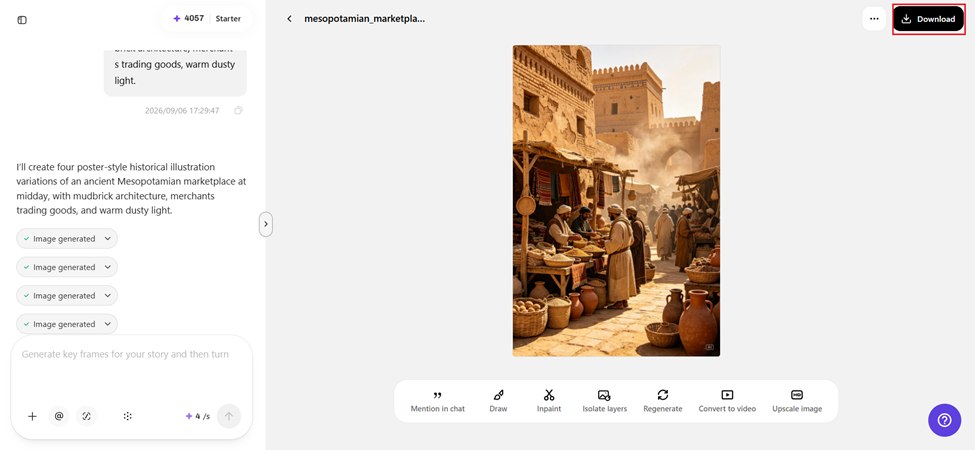
Step 1: Generate your civilization visual
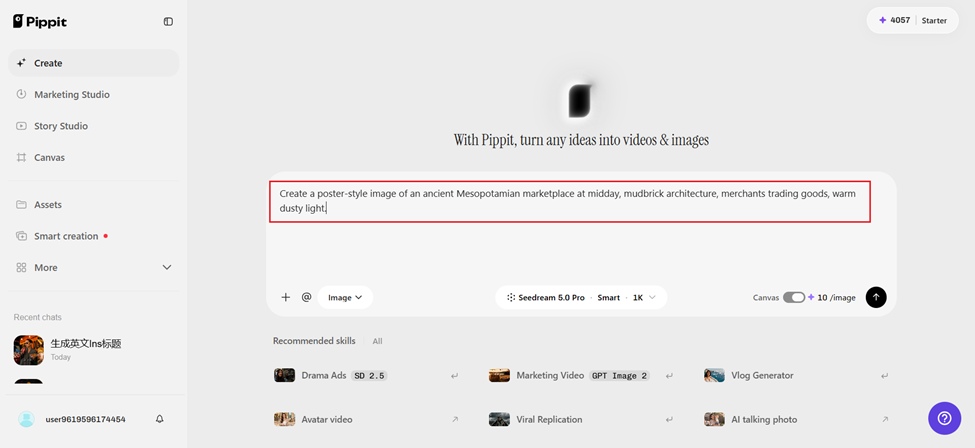
Open Pippit and select the Seedream model, then describe the scene using your actual research.
For example: Create a poster-style image of an ancient Mesopotamian marketplace at midday, mudbrick architecture, merchants trading goods, warm, dusty light.
Add archaeological reference images to keep the details grounded in real research.
Step 2: Verify accuracy with curatorial input
Review the draft with input from curators or historical consultants — does the architecture, clothing, and setting reflect current scholarly understanding of the civilization? Adjust anything that doesn’t align with the museum’s actual research.
Step 3: Add exhibit details and export
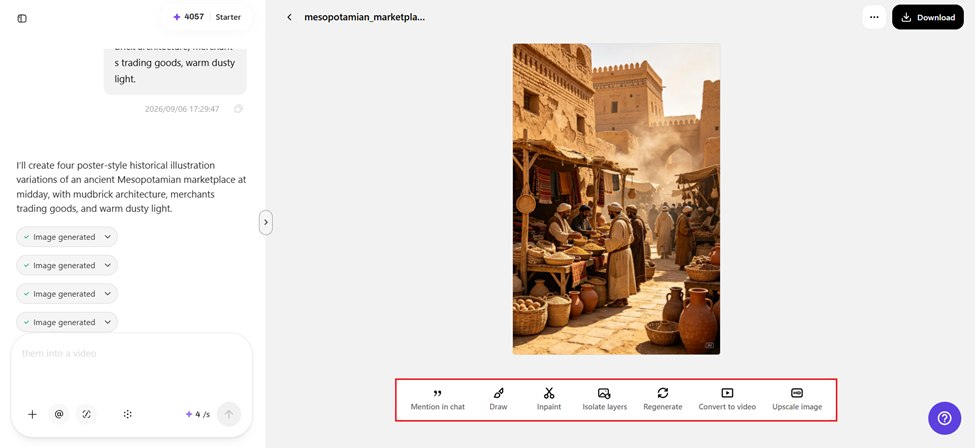
Layer on the exhibit name, civilization, or a short informational caption directly onto the image, then export at the resolution needed for exhibit signage, a promotional campaign, or a museum’s digital displays.
Making immersive exhibit content that holds up to scrutiny
- Always involve curatorial or academic review before finalizing any generated historical scene for public display.
- Tie generated content directly to specific artifacts on display, so visitors see the connection between the object and its context.
- Use touring or traveling exhibits as an opportunity to adapt existing content rather than rebuilding from scratch each time.
- Treat this as a genuine AI video generator for the museum’s broader exhibit program, useful across permanent collections, temporary exhibits, and educational outreach alike.
Narrating the exhibit with SeedAudio 1.5
Museum exhibits already rely heavily on narration, and SeedAudio 1.5 lets curatorial teams generate that spoken context directly to accompany a recreated historical scene, describing what’s being shown and why it matters. This narration can also be produced in multiple languages to support international visitors, extending an exhibit’s reach without recording separate voice tracks for each version manually.
Being transparent about recreation versus record
Any generated recreation should be clearly labeled as an artistic interpretation grounded in research, not a literal historical record — museums have an educational responsibility to help visitors distinguish between documented fact and informed visualization.
This distinction matters especially for civilizations with incomplete archaeological records, where a recreation necessarily involves some scholarly interpretation rather than absolute certainty.
Help visitors see the world behind the glass
An artifact in a case is only ever a fragment of a much larger, richer world. With Seedance 2.5 inside Pippit, museums can help visitors see that larger world, turning research into immersive visual context without the cost of a specialized historical animation studio.
If your next exhibit is ready to bring its civilization to life, it’s worth opening Pippit and letting visitors step a little closer to the past.